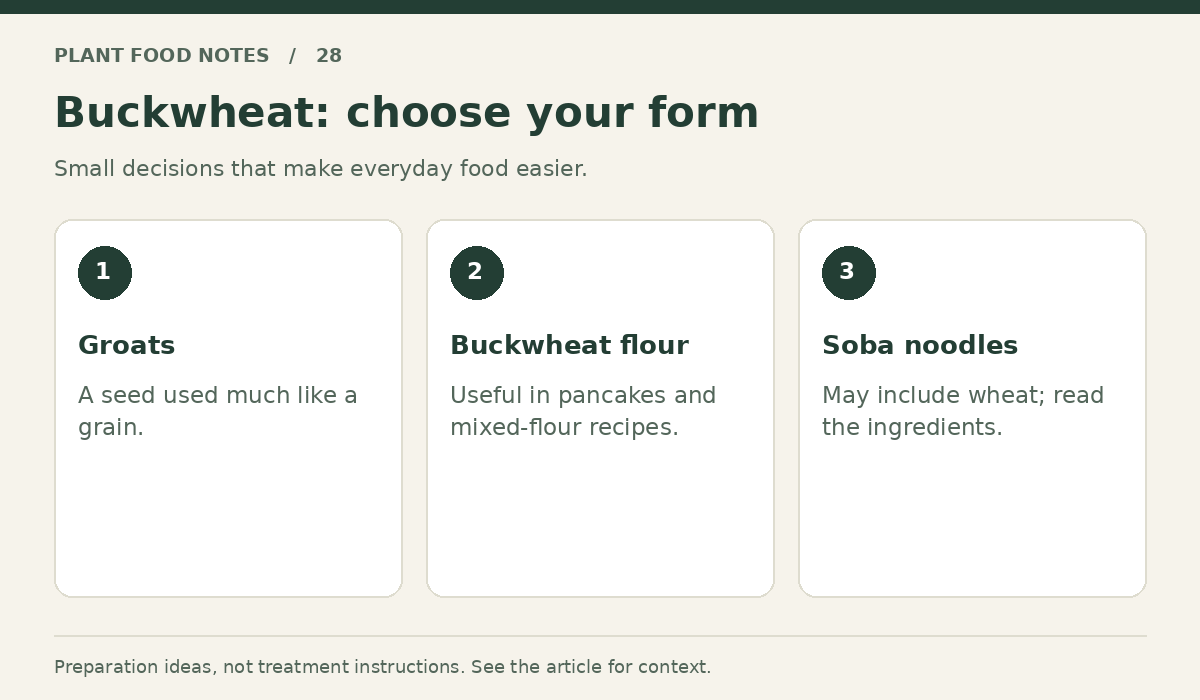
Despite its name, buckwheat is not wheat. It is a seed commonly used in grain-like ways, with an earthy flavour that can make breakfast, a savoury side dish, or a bowl of noodles more interesting. That naming confusion matters because people sometimes avoid it unnecessarily, while others assume that every product labelled buckwheat must be gluten-free. Both shortcuts can lead to poor decisions.
- Gluten-free seed, but not always a gluten-free product
- Fibre and variety are sensible reasons to use it
- Choose groats for a savoury starting point
- Make pancakes with realistic expectations
- Noodles need their own label check
- Be cautious with blood-sugar headlines
- Store it well and keep the routine flexible
Its practical nutritional appeal is a contribution of fibre, some protein, and minerals within a varied diet. It is not a treatment for diabetes or a reason to reject familiar grains. If you enjoy its flavour, buckwheat can broaden the range of staples you use. The most useful starting point is learning the difference between groats, flour, and mixed products before deciding how it fits your meals.
Gluten-free seed, but not always a gluten-free product
The NIDDK guide to food choices for coeliac disease includes buckwheat among naturally gluten-free options. However, a noodle or pancake mixture may combine buckwheat with wheat flour. Cross-contact during processing also matters for people who require strict avoidance. Read the product information rather than treating the word buckwheat as a complete safety statement.
This is especially relevant for soba noodles, where the proportion of buckwheat varies. Choose a product explicitly suitable for your needs if you have coeliac disease. Someone without a reason to avoid gluten can choose according to taste and nutrition more broadly. There is no automatic health advantage in avoiding wheat simply because another ingredient has a more unusual name.
Fibre and variety are sensible reasons to use it
Buckwheat groats can contribute fibre and make a useful alternative to a refined staple in some meals. The Harvard Nutrition Source discussion of whole grains explains why retaining grain components and considering the overall dietary pattern matter. Buckwheat is used alongside such foods even though it is botanically a pseudocereal rather than a cereal grass.
That context is more useful than promising a dramatic metabolic effect from a single serving. A meal containing buckwheat still needs to be considered as a whole. Sweet toppings, portion size, other ingredients, and individual needs affect the result. A packet of buckwheat biscuits is not nutritionally identical to cooked groats just because both use the same seed somewhere in the recipe.
Choose groats for a savoury starting point
Groats are the seed kernels, and some products are sold toasted. Follow the packet’s cooking directions because preparation and texture vary. Start with a small quantity while learning how your product behaves. If it becomes softer than expected, use that result in a dish that welcomes softness rather than assuming you have failed or that buckwheat can only be eaten one way.
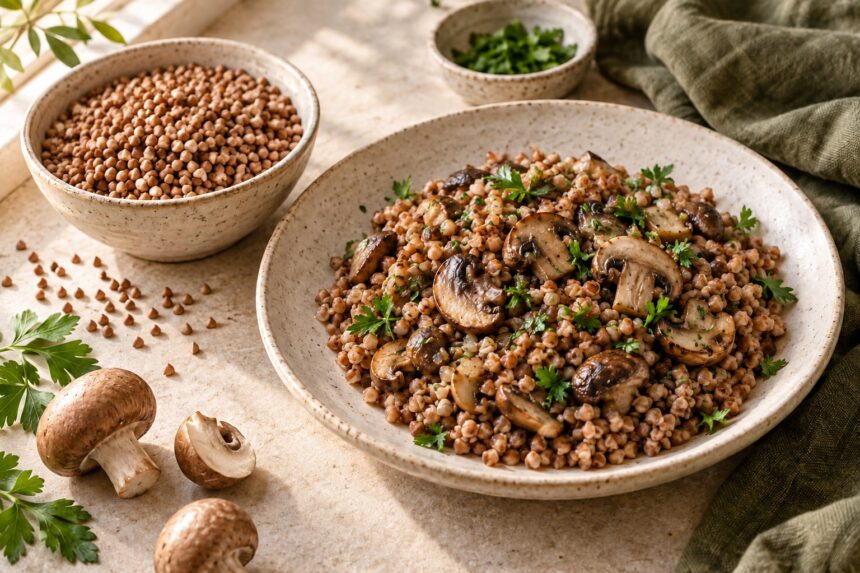
Cooked groats can accompany mushrooms, onions, roasted vegetables, or a source of protein you enjoy. Their flavour is more noticeable than plain white rice, so begin with a pairing that complements that earthy character. You can also introduce them alongside a familiar staple in separate portions. There is no need to redesign the entire meal just to try one new ingredient.
Make pancakes with realistic expectations
Buckwheat flour can give pancakes a distinctive flavour, but it behaves differently from wheat flour. Use a recipe designed for the flour or flour mixture you have, particularly if gluten avoidance is required. Substituting it blindly into a familiar recipe may change the structure and texture enough to make the result disappointing.
Consider the complete breakfast rather than the flour alone. A pancake with fruit and a suitable protein-containing accompaniment is different from a large stack covered in sweet toppings. Both can be enjoyed in context, but the word buckwheat does not make the added ingredients disappear. Aim for a breakfast that tastes good and provides enough food for the morning ahead.
Noodles need their own label check
Buckwheat noodles are convenient, but ingredients and serving suggestions vary widely. Check the cooking time and rinse or handle as directed by the manufacturer. If a noodle dish turns sticky or overly soft, the method may need adjustment. A brief practice meal is often more useful than buying several packets on the assumption that every brand will behave identically.
Build a noodle bowl with vegetables and an appropriate protein source, then use a sauce that suits your needs. Strong condiments can add substantial salt, so taste before adding more. The noodles provide one component of the meal, not a complete nutritional solution. Their main advantage may simply be that you enjoy them enough to cook a varied meal instead of skipping it.

Be cautious with blood-sugar headlines
Buckwheat contains compounds that attract research interest, but a list of those compounds does not establish a treatment effect from normal food portions. Studies may examine extracts, specific varieties, or particular groups of participants. Those details should not be erased when translating research into shopping advice. A food can be promising without delivering every result suggested by its marketing.
If you manage diabetes, fit buckwheat into your individual meal plan and monitor as advised. It still contains carbohydrate, and the portion and accompanying foods matter. Do not stop medication or assume glucose will remain unchanged because a product is described as low glycaemic. Personal responses and the complete meal are more useful than a single label used without context.
Store it well and keep the routine flexible
Keep dry groats or flour according to the packet’s instructions and protect them from moisture and pests. Whole-seed flours can lose quality over time, so a smaller bag may suit an occasional pancake routine better than a large bulk purchase. Cooked buckwheat needs the same attention to prompt cooling and refrigeration as other prepared grains or seeds.
Allergy to buckwheat is possible, even though it is different from wheat. Avoid it if you have a relevant diagnosed allergy, and seek advice about symptoms rather than repeatedly testing your tolerance alone. For those who can eat it comfortably, its value is variety: another useful staple with fibre, an individual flavour, and several cooking possibilities. Choose the form carefully and let enjoyable meals be the reason it stays in your kitchen.
General nutrition information; not personalised medical advice. Sources checked on 16 September 2026.